

The following article was written by In Business Staff Journalist, Brittney Kenaston, photo by Patricio Crooker
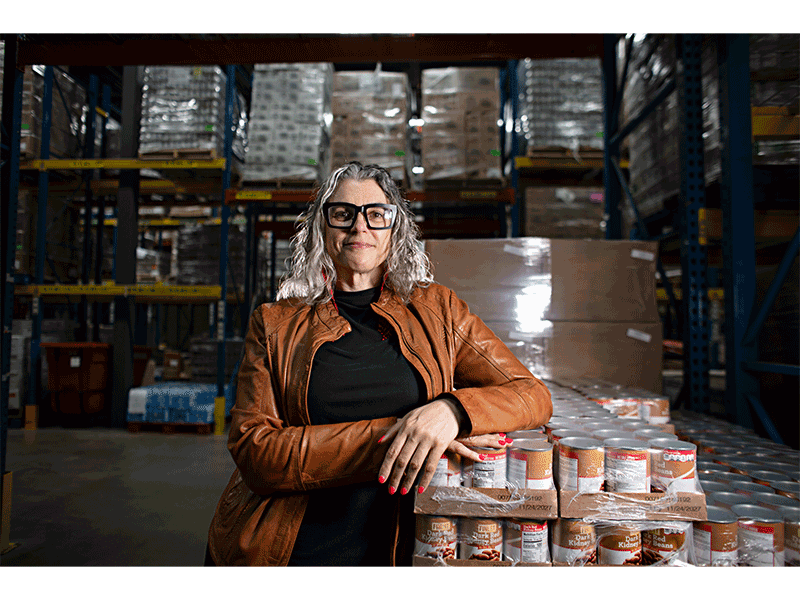
Nonprofit work is not for everyone, according to Michelle Orge, president and executive director of Second Harvest Foodbank of Southern Wisconsin, but for those with the right mix of passion, endurance and the ability to adapt, it can offer a rich and fulfilling career.
“Lives can be changed with food. Food is the center of so many things. It keeps folks alive, but it also provides so many other things. It’s fellowship, it’s celebration, it’s tradition. Everybody deserves good food,” said Orge, who talked to In Business Madison about leading one of the region’s largest food pantries, and her work serving the 130,000 people in 16 counties facing food insecurity.
What experiences led you to your current career?
My early jobs were in food service. I learned a lot waiting tables — a lot. I worked in a cooperatively managed restaurant (the Del Rio in Ann Arbor, Michigan), which was an interesting experience. There were no managers, but you still needed to get things done and help direct your coworkers. So there was leadership, without I guess what you consider authority, without the title. It was an interesting experience in leading by example, but also influencing and trying to work with folks and get things done without being officially the boss.
It taught me a lot about how to work with volunteers, how to approach things with folks who aren’t getting paid to do the work, and what their motivations are.
Especially in food banking, everything’s really rewarding, but there are some things you have to clean up. There are some things that are messy. There are some potatoes that aren’t so great. So it’s about asking folks to do some things that might not be what they expected when they came in that day… finding ways to approach that.
An opportunity became available at a food bank. It was for a volunteer coordinator. I thought, I could do that — it has to do with food, it has to do with management. So I applied for the job, and I got it.
I found that there were so many different things I could do in food banking, and every day was a new adventure. There was this great combination of feeling like you could accomplish something every day, and that you were helping to support folks with food.
At Second Harvest, you say hunger makes everything harder. Lives can be changed with food, and there’s enough food for everyone. I’ve always believed that, and getting food to folks every day is something that matters.
What are some of your proudest career moments?
A lot of my proudest moments or milestones are things that I’ve done with other folks or done as part of a team, or when a team that I’ve been on has really tackled a problem together.
It’s a positive and a frustrating thing, this “If you want to go fast, go alone. If you want to go far, go together.” I’ve been an impatient person in my career. I want to move forward, and I want to get things done, but when you include other folks in the process, it takes longer, but you get better results.
Everyone had a lot of things going on during COVID, but here in a food bank, there was so much going on. Our work ramped up so much, and we did things that I didn’t think we’d ever have to do. We doubled the amount of food that we were putting out in a building that we thought was at capacity, and now we’re at twice that.
Our ability to pivot and change, and respond to the community, and be flexible and adapt, that has been a pretty proud moment. The growth that we’ve encountered and the opportunities that we’ve embraced through that, I’ve been proud of that as well, for our organization and for myself as a leader.
We’ve also had an opportunity to support local agriculture and local business. We’re a nonprofit, but we’re also a consumer of goods. We purchase things, we purchase food, and when we can align that with our values, that’s really great. If we can support the local economy and help folks in the process, that’s really something that we can be proud of.
(Our) Farm to Food Bank Initiative is paying farmers a fair market price for their food, which supports them, contributes to the local economy and gets really great food to folks.
We’ve been able to be a model for other programs around the country and it has really helped farms.
As a leader, what have been your greatest challenges?
In some businesses, the busier you are, the more customers you have and the more revenue you have. For us, the more neighbors that need support, the more it costs, right? And the more donations we need, the more we need to ask the community to help support us.
We don’t receive public funding, and so it’s the generosity of the community, individuals, foundations and the business community that really supports us. When the need increases, then we have to increase our fundraising. And folks really do step up, so while it’s a challenge, it’s also been rewarding.
The other challenge is the lack of control we have over what causes food insecurity … our lack of affordable housing, lack of access to affordable health care, low wages, systemic racism, poverty. We don’t tackle these alone, and we don’t tackle these always directly, but we can partner with others that do this work by giving them food. We’re a supplier.
There’s also a challenge in knowing that there’s enough food for everyone, there is food out there, and we’re not able to get to all of it because of our capacity constraints. As the primary source of food for most of our 300 partners and programs in the 16 counties that we work in, it’s really challenging to know that more food could be going out to these partners, if only we had the capacity to be able to do that.
How do you balance those challenges with celebrating your victories and achievements?
Every day I work hard to think of ways to better support our partners and neighbors, but we also need to acknowledge the work we’re doing. … We’re at more than two million pounds of food distributed a month, and prior to the pandemic, it was about a half a million pounds per month.
It can be easy to focus on the “This isn’t enough,” and it isn’t enough because our partners need more. But also, it’s more than it was.
What is your vision for your career and the organization’s future?
What are the opportunities for us to expand our capacity? We’re looking at how we can overcome our immediate challenges, and what our long term opportunities are.
Part of what we do here at Second Harvest is we get food from sources, and that food needs to be made family-ready. It comes in these giant bins — these huge containers of frozen peas, like those boxes that watermelons come in at the grocery store. Imagine one of those twice as tall, full of frozen peas. Those have to be put into smaller bags, so we work with volunteers and our staff to… make that food family-ready.
The capacity challenges are that we don’t have the room to safely do that repackaging in the quantities we’d like, so we’re turning away the opportunities to take in some of that food.
There are volunteers who want to work with us, but we have to say no because we don’t have the space for them to safely work in our building.
It feels so disappointing to be turning away offers of help and food that’s out there, and so what we’re looking forward to in the future are ways to work with more volunteers, take in more of that food and make more of that food family-ready for our partners.
We also know that solving this and ending hunger isn’t just about food. It’s about community engagement. It’s about advocacy.
What message would you share with other professionals, particularly in the nonprofit space?
I’m an alumni of the University of Michigan … and because I work in a nonprofit, several years ago I was asked to go back and speak to folks who are interested in becoming part of the nonprofit world.
I said, it’s not just about passion, and passionate folks aren’t always going to be successful in nonprofit work. And just because you’re passionate about a mission, that does not mean that nonprofit work is for you.
And a few folks were leaving the room — they were just so disappointed that I was crushing their dreams, but it’s not just passion you have to have. You have to have skills. You have to have endurance. You have to be able to be flexible and adapt and be an innovator, and innovation does not always mean new fancy drones delivering food. It means taking what you’ve got and reworking it some other way.
